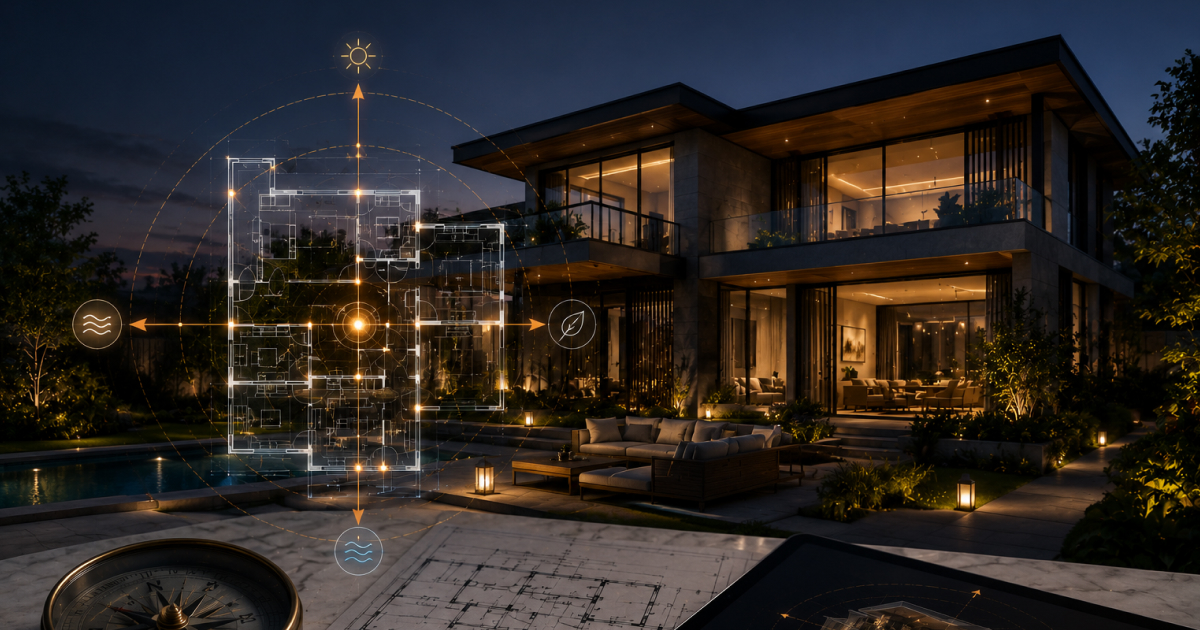

You’re all set to design your dream space, excited about your choices, when someone asks, “What about Vastu for the home?” At first, you may brush it off, but then you remember that Vastu has been a part of tradition for generations. It’s always been woven into rituals, but with so much misinformation and so many self-proclaimed experts around, finding an expert Vastu consultant in Ahmedabad practicing logic-led advisory for spaces becomes important.
The reality? A space that looks right and a space that works right are not always the same thing. An energy-efficient Vastu home isn’t just about placement and direction; it’s about how the space is engineered to support how you actually live, work, and move through it. And the gap between a beautiful design and a truly functional one doesn’t announce itself. It quietly shows up in the way a room never quite feels settled, in the decision that keeps getting delayed, or in the workday that ends with more friction than it should.
Sound familiar?
That’s when you start thinking: what if there’s a more logical, engineering-based way to approach Vastu? Working with an engineer-led Vastu expert in Ahmedabad can help you move beyond assumptions through a Spatial Vastu evaluation grounded in technical analysis and functional realignment. This is where true value is brought.
The solutions are already in your blueprint. They just need to be looked for the right way.
You may recognise some of these patterns in your own experience. Whether you are a builder in Ahmedabad planning a residential complex, a business owner in Gujarat refining a commercial space, or a homeowner preparing for renovation, the difference often lies in how precisely the space is evaluated.
A property may appear functional on the surface. Yet factors such as layout, orientation, movement flow, directional balance, and site slope can quietly influence how it performs over time. In a logic-led Vastu approach, this level of reading goes beyond surface observation. It involves the assessment of 16 zones and 32 sub-directions, where accuracy becomes especially important. When supported by precise layout and site analysis, the evaluation becomes more structured, dependable, and meaningfully aligned.
What Gets Prioritized | What Gets Overlooked |
Choosing a location based on price and visibility | Overlooking directional exposure and how sunlight, wind, and energy flow through the space over time |
Designing a layout based on aesthetic appeal and trends | Ignoring how people naturally move through the space and where friction points emerge |
Planning floor allocation by square footage alone | Missing functional alignment between purpose and spatial positioning |
Setting timelines based on construction schedules | Not accounting for spatial inefficiencies that will require costly rework later |
Finalizing designs without spatial engineering review | Discovering workflow bottlenecks, productivity drops, or persistent discomfort after occupancy |
Here’s what separates spaces that truly work from spaces that merely exist: most property decisions are made without understanding the engineering behind strategic spatial alignment and energy flow analysis. Without that foundation, even the most beautiful design becomes a compromise.
When it comes to optimizing spaces, most people have heard of Vastu. But traditional approaches with rituals and symbolic placements often miss how a space actually performs. You’re left without real answers:
That’s where Spatial Vastu changes everything. It removes guesswork and focuses on what truly matters: how your space functions, how people move through it, and where inefficiencies quietly exist. Instead of relying on symbolic corrections, you get spatial harmony supported by technical analysis. You do not simply assume a placement works; you understand it does because it has been evaluated with precision.
This approach uses directional alignment maps and structured spatial order to guide decisions. It’s not about following tradition—it’s about realigning your environment so every corner supports your needs, whether you’re managing a commercial property in Gujarat, designing a residential complex in Ahmedabad, or optimizing your home.
When every decision counts, you can’t afford guesswork. Spatial Vastu gives you the precision that traditional vastu shastra for interior design in Ahmedabad simply doesn’t.
The difference is measurable, and it shows up in how your space actually performs.
| Traditional Vastu | Spatial Vastu |
| Focuses on rituals and symbolic fixes | Relies on engineering-grade spatial audits and technical analysis |
| Emphasizes cultural practices and spiritual guidelines | Uses data-driven, functional realignment based on space usage |
| Often includes visual adjustments such as objects and colors | Focuses on minimal-change interventions with maximum impact |
| Applies broad, generalized rules without deep spatial analysis | Conducts a blueprint-level analysis of layout, direction, and flow |
| Based on cultural beliefs and symbolic representations | Grounded in spatial order, functional alignment, and logical structure |
| Positioned around traditional practices | Positioned as a strategic consultancy for optimizing spaces and environments |
By embracing Spatial Vastu, you’re applying a modern, engineered approach to create spaces that work for you. For anyone planning Vastu for a new home in Ahmedabad, this means optimizing every aspect of the environment for maximum functionality and clarity. In high-value properties and critical spaces, these decisions make all the difference, transforming your space into one that truly supports your goals and delivers energy-efficient Vastu home performance.
A spatial order audit is like giving your space a thorough check-up, just like a mechanic A spatial order audit is like giving your space a thorough check-up, just like a mechanic examines a car. By ensuring proper spatial arrangement based on directional alignment and sacred geometry, it improves how well your space works, making it more comfortable and efficient.
The Compounding Benefits of Getting It Right:
Why Timing Matters: A spatial audit before key decisions is the only stage where findings can fully reshape your outcomes. Once built, your options narrow. Once occupied, change becomes costly. The audit is where you gain maximum leverage—where vastu compliant layout principles and engineering insights prevent problems instead of fixing them later.
This is how spaces transform from functional to truly effective.
When you buy or build a property, the first decisions you make set the stage for everything that follows. Think of it like planting a tree—the way you position it, the direction it faces, the soil around it—these early choices determine how it grows over decades. To ensure you get it right from the start, consulting a residential Vastu consultant in Ahmedabad who practices logic-led advisory can help guide these critical decisions, ensuring that your property thrives just like a well-planted tree.
The difference between a property that works for you and one you work against is decided early.
An engineering-based Vastu evaluation matters at every stage of your property journey. Here’s where it makes the biggest difference:
The key point: evaluate early, plan smartly, and use engineering-based alignment at every step. That’s where real value happens.
An early spatial evaluation isn’t just for perfectionists or believers in tradition. It’s for anyone who wants their space to actually work.
Here’s who benefits most and why.
The real question isn’t whether you can afford an evaluation. It’s whether you can afford not to have one. That’s where the difference between a good space and a truly exceptional one begins.
Timing changes everything. The earlier you evaluate, the more options you have. The later you wait, the more expensive and complex solutions become. Here’s exactly when an evaluation delivers the most value.
The difference between a space that merely exists and one that truly works is often decided by when you evaluate. Don’t wait until problems are obvious. Evaluate when you still have options.
When a property is built without a spatial audit, the problems aren’t always obvious at first. But they show up quietly, consistently, in ways that cost you time, money, and peace of mind.
When a property is built without a spatial audit, the problems aren’t always obvious at first. But theThe question isn’t whether you can live with these compromises. The question is: why would you, when evaluation could have prevented them entirely?
An engineering-based Vastu evaluation isn’t mystical or vague. It’s a structured, technical process that examines how your space is actually designed and how it will perform. When you work with a trusted Vastu consultant, this evaluation ensures that every detail is carefully considered for optimal alignment. Here’s exactly how it works.
Step 1: Strategic Consultation: Understanding your business objectives, project challenges, and execution stage. We listen to what you’re trying to accomplish, where friction exists, and what constraints you’re working within. This conversation sets the foundation for everything that follows.
Step 2: Technical Survey- On-site and drawing-based spatial diagnostics reveal how your space is actually configured. We examine layout structure, directional accuracy, zone positioning, and movement pathways. This is data-gathering—seeing what’s really there, not what’s assumed.
Step 3: Diagnostic Report- We identify hidden spatial resistance zones and opportunity areas. This report shows exactly where problems originate, why they exist, and where strategic changes will have the biggest impact. No guesswork. Just clear findings grounded in spatial analysis.
Step 4: Strategic Realignment Plan- We provide minimal-change, high-impact corrective recommendations. These aren’t overhauls. They’re precise adjustments—repositioning zones, optimizing flow, correcting directional alignment—that transform how your space functions without unnecessary reconstruction.
Step 5: Implementation Guidance- We coordinate with your architects, engineers, and site teams to ensure recommendations are executed correctly. This isn’t a report you figure out alone. We guide the process so changes are implemented as intended.
Step 6: Performance Stabilization- Follow-up ensures sustained spatial and operational flow. We verify that adjustments are delivering the expected results and make fine-tuning adjustments if needed. Your space continues to perform as designed.
This systematic approach ensures clarity, precision, and real results.
What distinguishes this approach is its rational, engineering-led perspective on spatial realignment. Informed by the expertise of top Vastu consultant in Ahmedabad, Jayesh Pandya, and his work in Vastu and property energy consulting, it brings architectural precision and environmental logic into thoughtful alignment, ensuring the advisory remains measured, relevant, and practically grounded.
When a space is understood with greater care, it begins to support more than just physical function. It can bring clearer thinking, steadier decisions, more effective action, and a greater sense of ease in how daily life or work unfolds. That is why the right evaluation, done at the right stage, often shapes far more than the layout itself; it influences the quality of everything that follows. This is the role Vaastu Vidyaa is intended to serve: a premium, engineering-led advisory practice centred on spatial audit and strategic realignment. By studying layout, orientation, usage, movement, and spatial order, the focus remains on identifying hidden spatial resistance and guiding practical, minimal-change corrections with architectural respect. Whether the need is to better define a property’s usage objective, understand directional and energy patterns, identify resistance points, or receive strategic alignment guidance, the intention remains the same: to help the space support life, work, and outcomes with greater clarity, balance, and purpose.
Not in the usual sense. Vaastu Vidhyaa approaches the subject through spatial audit and strategic realignment, with focus on layout, orientation, usage, and movement rather than ritual-led or fear-based advice.
If a property feels visually complete but functionally unsettled, under-supportive, or slightly resistant in how it performs, a structured review can help identify what may be misaligned.
A. No, it extends beyond homes. Across Ahmedabad and Gujarat, the advisory is relevant for residential, commercial, and project-stage properties, with the review guided by how the space is meant to function, support outcomes, and align with its intended use.
No. The emphasis is on practical, minimal-change recommendations that respect what is already built and work within the existing architectural framework.
The difference lies in the approach. Vaastu Vidhyaa is rooted in engineering-led spatial understanding, where recommendations are guided by logic, directional accuracy, and practical alignment, not dependency, superstition, or generic fixes.
© 2026 | All rights reserved by Vastu Vidhya Consultancy.