People invest significantly in premium homes and high-value properties across Ahmedabad, Gandhinagar, and Gujarat with the expectation that thoughtful design, a strong location, and a well-planned layout should naturally create a space that feels complete. And often, visually, it does. Yet that is not always the same as true spatial alignment.
A space can appear refined, well-resolved, and even seem right on paper, while still carrying subtle forms of imbalance that only begin to reveal themselves over time through the way the environment feels, flows, and supports everyday life. In premium properties, what feels off is rarely obvious. It is quiet, easy to dismiss, and difficult to explain.
A premium advisory practice focused on spatial audit and strategic realignment, led by a trusted Vastu consultant in Ahmedabad, offers a meticulous approach to enhancing your space. By blending technical precision with architectural respect, this practice helps identify hidden spatial resistance and implements changes that optimize functionality and flow, ensuring your environment supports your goals with minimal disruption.
Even premium spaces can feel slightly unresolved over time. Not because the design lacks quality, but because real life gradually exposes what visual refinement alone cannot solve. What appears complete on the surface may still carry subtle friction in how the space flows, functions, and supports everyday use. In most high-value spaces, this usually comes down to a few recurring patterns:
What Happens | What It Means |
The space was designed for a past version of you | A spatial audit helps reveal where lifestyle, routine, or use has shifted beyond the original plan |
The space looks refined, yet does not feel fully at ease | Functional optimization addresses the gap between visual excellence and lived comfort |
The design feels complete, but subtle friction keeps surfacing | Hidden spatial resistance often appears in flow, movement, and daily usability |
Some aspects feel outdated or slightly misaligned over time | Strategic realignment helps separate what is aging visually from what still works structurally |
The space reflects aspiration well, but daily function feels uneven | Logic-based recommendations and directional accuracy help align design intent with practical use |
Over time, these are the kinds of shifts that make a premium space feel slightly unresolved. The issue is rarely obvious, but it is often precise. When read correctly, it opens the door to more thoughtful refinement rather than unnecessary change.
In high-value projects, subtle engineering-led Vastu realignment is not about reconstruction. It is about reading the existing space more precisely and improving it without disturbing its core design. Through strategic realignment, the focus stays on what already exists. The structure is respected. The visual language remains intact. The goal is to bring directional accuracy, layout logic, and functional optimization into better alignment. That is precisely why this approach resonates so strongly with premium homes, private estates, and high-value projects across Ahmedabad, Gandhinagar, and Gujarat, where design quality is already high, and what matters most is how quietly and intelligently the space is brought into better alignment.
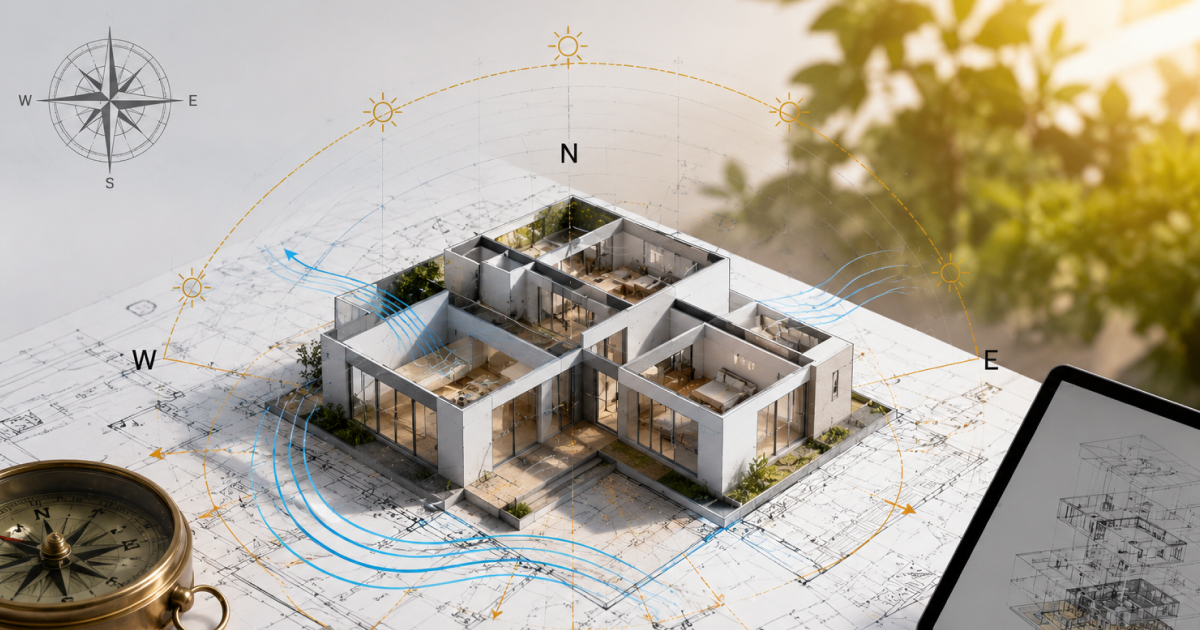
It also reflects a more technical method of evaluation. A trusted vastu advisor in Ahmedabad understands that the reading of a property can extend across 16 zones and 32 sub-directions, which requires precision rather than assumption. Tools such as AutoCAD help study layout accuracy, while Google Earth helps assess site slope, including the important South West to North East movement, with greater clarity
This is what gives the process its value in premium spaces. The space is not dramatically changed. It is more precisely aligned and, therefore, better able to support how it is meant to function.
In premium spaces, the real difference lies in the method. A more refined approach begins with spatial logic, respects the existing architecture, and recommends only what is truly necessary. That is what makes it more relevant for a Vastu-compliant home layout or a high-value home architecture design project where precision matters.
Checklist for a More Refined Approach | |
Begins with a spatial audit | ✓ |
Following strategic alignment | ✓ |
Uses direction accuracy and logic-based recommendations | ✓ |
Prefers minimal-change intervention | ✓ |
Maintains architectural respect | ✓ |
Focused on functional optimization and spatial clarity | ✓ |
Uses a discreet, consultant-led approach | ✓ |
Supports better spatial energy balance | ✓ |
In high-value projects, that difference is not loud, but it is meaningful. The space is not forced into change. It is refined with greater precision and restraint.
A space can be visually complete and still feel quietly unresolved. Not broken — just slightly resistant. The furniture fits, the proportions hold, the design reads well. But something in the daily experience of it doesn’t fully settle. Most of the time, the answer isn’t more. It’s more precise.
A client once described her bedroom as feeling “heavy in the mornings.” Beautiful room. Considered design. No clutter, no obvious fault. But the bed sat with its head pointing North — directly into the zone of magnetic pull, the direction least suited to stillness and recovery. One reorientation, head pointing South. Within weeks, the mornings felt lighter. The room hadn’t changed. The experience of waking up in it had.
In high-value environments, even micro-level alignment can influence how a space functions and feels over time.
The North East corner of a home is its most energetically open zone — the direction of clarity, lightness, and unobstructed flow. It isn’t meant to hold weight. Yet in most spaces we audit, it’s exactly where a heavy console, a storage unit, or a stacked shelf has quietly settled. Added for convenience, never questioned. The zone doesn’t collapse visibly. It just gradually dulls — and the home loses a quality of ease that occupants can feel but rarely locate.
Small inefficiencies, when left unexamined, accumulate into an experience that feels persistently off.
A founder worked long hours from a home office situated in the South East — the zone of fire and activation, suited to energetic output. But his desk faced South, pulling focus outward rather than inward. Creative in bursts. Restless between them. Repositioning the desk to face East — the direction of clarity, solar intelligence, and sustained concentration — shifted the quality of his working day within a fortnight.
Through spatial audit and strategic realignment, subtle refinements can support stronger functional optimization — without touching a single design element.
Directional accuracy isn’t intuitive. It’s applied. A dining space in the South East — the fire zone — supports appetite, conversation, and the natural ease of a shared meal. The same table placed in the South West creates a heaviness that lingers well past the meal itself. Neither placement looks wrong. One simply performs better. And a logic-based recommendation makes that distinction without disrupting what the designer built.
With directional accuracy and precise recommendations, minimal-change intervention can create impact that compounds quietly over time.
The goal was never to make the space look different. It was to make it work differently — with the same walls, the same light, the same materials. A consultant-led approach that respects what the architect and designer built, and finds within it the small corrections that shift how the space actually performs.
Not renovation. Realignment. And in premium environments, that distinction is everything.
This level of realignment becomes relevant when a property already looks complete, yet still feels capable of functioning with greater clarity and ease. In premium environments, the need is rarely for dramatic change. It is more often for a finer reading of how the space is performing, where subtle misalignment may still be limiting comfort, flow, or long-term usability.
This is where the value of subtle realignment becomes clear. The space does not need to be remade. It needs to be understood more precisely.
Sometimes a space doesn’t need more work. It needs more accurate work. These are the moments when the best Vastu consultant in Ahmedabad can make a difference, using a spatial audit as the most useful tool in the room to ensure precision and alignment.
What improves is not just the layout, but the way the space begins to support life within it more naturally.
Even in a premium property, visual completeness does not always mean the space is functioning at its highest level of alignment. This is where Vastu consultation in Ahmedabad becomes crucial. When subtle misalignment is left unrefined, the effect is rarely dramatic, which is why it is often overlooked. Yet the space can continue to carry a quiet layer of resistance that influences how it feels, how naturally it functions, and how consistently it supports everyday life over time. The design may remain strong, the execution may appear refined, and still, a subtle gap can persist between what the space shows outwardly and what it continues to hold within its daily experience.
In premium spaces, that difference may be subtle to the eye, but meaningful in the way the property is lived, felt, and sustained over time.
Most spatial issues don’t announce themselves. They accumulate in how a space feels to move through, work in, or rest within. At Vaastu Vidyaa, Jayesh Pandya approaches this not as a traditional practice but as a spatial discipline, engineering-led, rationalist in method, and precise in execution.
The work begins not with an assumption but with analysis.
This is the gap Vaastu Vidyaa bridges between architectural precision and the environment a space creates. Not through belief, but through disciplined spatial reading.
For those in Ahmedabad and Gandhinagar seeking exactly this, a structured, engineering-grade approach to spatial alignment that works within the language of design, Vaastu Vidyaa offers a starting point worth considering.
A premium space earns its value not just in how it looks, but in how consistently it supports the people within it. When that support feels even slightly incomplete when the flow isn’t quite right, when a room never fully settles, when daily function falls just short of the design’s promise — the answer is rarely more. It is more precise.
That precision is what Vaastu Vidyaa brings to every engagement. Through energy and directional analysis, each space is read for what it carries, not just visually, but spatially. Through property usage and objective understanding, the audit goes beyond surface observation to examine how the space is actually being lived in, worked from, or built around. Through a structured Vastu audit and strategic alignment guidance, the recommendations that follow are minimal in intervention and meaningful in outcome.
The architecture remains intact. The design intent is respected. What improves is the quiet intelligence with which the space performs.
For those who have already built well and want to ensure the space works as precisely as it looks — this is where that conversation begins.
Yes — this approach is specifically suited to spaces that are already built or nearing completion. The audit works within what exists, identifying where subtle spatial misalignment may be limiting how the space performs, without proposing changes to the design itself.
The method here is engineering-led and rationalist in approach. It begins with a structured spatial audit — directional mapping, zone analysis, layout logic — rather than ritual or assumption. Every recommendation is grounded in spatial reasoning and made with full respect for the existing architecture.
Rarely, if at all. Most recommendations involve orientation, placement, or zone usage — adjustments that are functional rather than visible. The design intent and aesthetic remain fully intact.
It covers directional accuracy across zones, movement and flow within the layout, orientation of key spaces such as bedrooms, workspaces, and living areas, and identification of hidden spatial resistance that may be affecting daily comfort or functional ease.
Yes. Workspaces, offices, and business environments benefit from the same level of spatial precision — particularly where focus, stability, and consistent daily performance are priorities.
Vaastu Vidyaa works with premium homeowners, architects, developers, and project consultants primarily across Ahmedabad, Gandhinagar, and Gujarat.
© 2026 | All rights reserved by Vastu Vidhya Consultancy.