HomeBlogHow Better Space Planning Can Support Business Performance, Team Harmony, and Everyday Living
Commercial
How Better Space Planning Can Support Business Performance, Team Harmony, and Everyday Living
May 2026 | Vastu Vidhya
You’ve seen it before: a space that looks like a million bucks on Instagram but feels like a confusing maze in reality. It’s the “uncanny valley” of architecture. The marble is polished, the lighting is moody, and the furniture costs more than a mid-sized sedan—yet, for some reason, the energy in the room has the charisma of a damp sponge.
For factory owners, plant managers, and warehouse operators in Ahmedabad–Gandhinagar, misaligned layouts silently reduce throughput, focus, and efficiency. Congested shop floors, interrupted production lines, or cluttered storage zones create hidden bottlenecks.
You don’t need more machines — you need spatial intervention and layout optimization. By applying vastu for business growthprinciples, small adjustments can streamline workflow, improve material flow, and boost operational output, letting your facility work for you, not against you.
The Invisible Friction…..
We’ve all walked into a store, felt instantly confused, and walked straight back out — without buying anything. The product was right. The price was right. But something about the space just felt off, and nobody could explain why.
Most business owners blame slow sales on marketing or the market. Very few stop to look at the space itself. But your floor plan isn’t just a drawing — it’s the silent rulebook your customers follow the moment they walk in. Get it wrong, and no amount of advertising will fix what the room is actively undoing. Get it right, and the space starts doing the selling for you.
What Better Space Planning Means Beyond Traditional Vastu Conversations
Let’s be honest: most people think Vastu is just about where to put your water pot or which way your head should face while you sleep. But if you’re running a business, you don’t need superstition; you need strategy.
The difference between a “pretty” room and a “high-performing” space is like the difference between a decorative cake that tastes like cardboard and a Michelin-star meal. One looks good on a brochure; the other actually sustains you. Here is how we move beyond the “zen” and into the “ROI.”
When we talk about space planning, we aren’t just talking about aesthetic harmony. We are talking about how to accelerate sales and operational efficiency using vastu for business growth by treating your floor plan like a high-performance engine. If the pistons (your departments) are firing in the wrong order, the car stays in the garage.
The “Traditional” Vastu
The “Engineering-led” Lens
The Real-World Outcome
Ritual-focused: “Put the desk here because it’s lucky.
Flow-focused: “Put the desk here to minimize friction and maximize focus.”
Decisions happen faster; the “mental fog” of a bad layout lifts.
Visual Design: “Does the wallpaper match the brand colors?”
Circulation Study: “Do customers get trapped in dead zones or guided to the POS?”
How to accelerate sales using your space becomes a technical reality.
Static Blueprint: A drawing of where walls exist
Working System: A map of how energy, people, and money move through the building.
You stop paying rent for “dead square footage” that no one actually uses.
Assumption-led: “People should enter through here.
Usability-led: “People actually move through here; let’s optimize it.
Reduced “spatial frustration”—customers stay longer and spend more.
Why Your Interior Designer Might Be Ghosting Your Bottom Line
An interior designer’s job is to make a space look finished. An advisor’s job is to make a space work. You can have the most expensive Italian marble in the world. Still, if your layout forces your sales team to sit in a “conflict zone” or pushes your customers into a corner where they feel ignored, that marble is just a very expensive paperweight.
Better space planning means looking at your property as a working system. It’s the cold, hard engineering logic applied to the way humans behave in a room.
The Engineering-Led Evaluation
Traditional Vastu often gets a bad rap for being “mystical.” Filter it through an engineering lens, and it becomes something else entirely — technical, diagnostic, precise. It’s about:
Directional Alignment: Using the natural orientation of the earth to support human biology, not just tradition.
Blueprint Clarity: Locating the structural bottlenecks before the first brick is laid.
Usability: If a room looks great but is always empty, the design failed. Period.
Jayesh Pandya doesn’t deal in belief. He deals in Environmental Logic — technical zone mapping, structural assessment, and identification of spatial friction that impacts operational flow, executive clarity, and asset performance. Because understanding how to accelerate sales using your space starts long before the furniture arrives — it starts at the floor plan. From industrial plants and luxury residences to commercial properties, every square foot is measured, mapped, and strategically aligned.
This is precision-based spatial intelligence — and it’s nothing like what you’ve heard before. Click to see the difference
Because at the end of the day, a space that doesn’t help you grow is just a box — and you’re paying far too much for a box.
Why Can Well-Designed Spaces Still Underperform in Daily Use?
You’ve spent a fortune on a space that looks finished — yet living or working in it feels quietly exhausting. That’s because visual completion doesn’t guarantee functional clarity. A beautifully designed space can still produce subtle friction in the way people move, focus, and recover within it.
When activity zones and movement flow fall out of sync, even polished spaces create hidden inefficiencies that erode comfort and performance over time. The issue is rarely poor design — it’s that aesthetics alone cannot account for how a space performs under real, everyday use.
Jayesh Pandya looks behind the Italian marble to read the “circuitry” of a room. Ignoring directional logic is like flying without instruments — the seats might be leather, but you’re still headed for the mountains. By applying vastu for business growth principles, you can ensure your space aligns with operational flow and productivity. Because if you’re serious about accelerating sales using your space, the answer is never in the wallpaper. It’s always in the flow.
The Invisible Distraction – Industrial Use Case
In a manufacturing plant in Ahmedabad, high-traffic zones crossed critical workstations. Workers’ focus kept breaking, errors increased, and productivity lagged. No walls or machines were moved. The solution: realign zones, separate workflows from traffic, and shift key stations to quieter areas.
Result: efficiency improved, errors dropped, and mental fatigue eased — all without major expense.
Your industrial space silently impacts focus, workflow, and output. The hidden cost isn’t machinery — it’s the friction your layout creates.
How Does Directional Accuracy Improve Space Planning?
Most people treat direction like a basic weather app—North is cool, South is hot, and that’s about it. But broad assumptions are the fastest way to build a beautiful room that no one wants to enter. Real spatial performance depends on how specific sub-directions align with actual human activity.
Why directions should be assessed with precision instead of broad assumptions
If you think all East-facing entrances are equal, you’ve been misled. Performance depends on plot geometry, slopes, and adjacent structures. You wouldn’t fix a Rolex with a sledgehammer, so don’t use “one-size-fits-all” rules for unique real estate. This is where a certified Vastu consultant, Ahmedabad, earns their keep—by reading the property as it actually sits, not just quoting a generic book.
How directional zones and sub-directions help clarify the most suitable use of each area
Think of your floor plan as a biological map. Certain zones are built for adrenaline; others for rest. Put your sales team in a “rest” zone, and they’ll spend more time on vacation apps than closing leads. A vastu-compliant interior ensures the room’s “frequency” matches the job description.
Why entrances, work zones, and movement paths need directional clarity
Accuracy makes a space feel “inevitable” rather than “awkward.” Whether it’s a leadership cabin or a retail aisle, orientation dictates the experience. This level of technical detail is why a Vastu home visit, Ahmedabad—using actual instruments on-site—beats a “just-send-me-the-photo” remote consultation every single time.
How accurate directional reading supports recommendations specific to the property
When you stop guessing and start measuring, you unlock how to accelerate sales using your space. You move from “I think this looks okay” to “I know this works.”
Most spatial problems aren’t structural. They don’t require demolition or redesign. Sometimes the space is simply blocked — energetically misaligned in ways that quietly suppress flow, clarity, and forward movement. When results slow down, people blame strategy. Very few look at the room they’re sitting in.
The Blocked Office – A Use-Case Study
A mid-sized business in Ahmedabad had no obvious operational problems. The team was capable, the location was good, the strategy was sound — yet the energy inside the workspace felt inexplicably heavy. Decisions stalled. Momentum never built. Growth plateaued without a clear reason.
No structural changes were possible. The space was rented, the layout fixed, and the walls stayed exactly where they were.
This is where Vastu Urja Manjusha came in — not as a renovation, but as an energetic realignment. Designed specifically for offices, shops, industries, workspaces, and homes that feel stuck or blocked, it works within the existing structure to restore directional balance and spatial clarity. If you’ve ever felt your space working against you without knowing why,this might be the 60 seconds that finally explain it.
The heaviness lifted. Movement returned — in decisions, in team energy, in business flow. Same office. Same walls. The interference, finally, is gone.
Why Should Slope, Orientation, Layout, and Movement Be Studied Together?
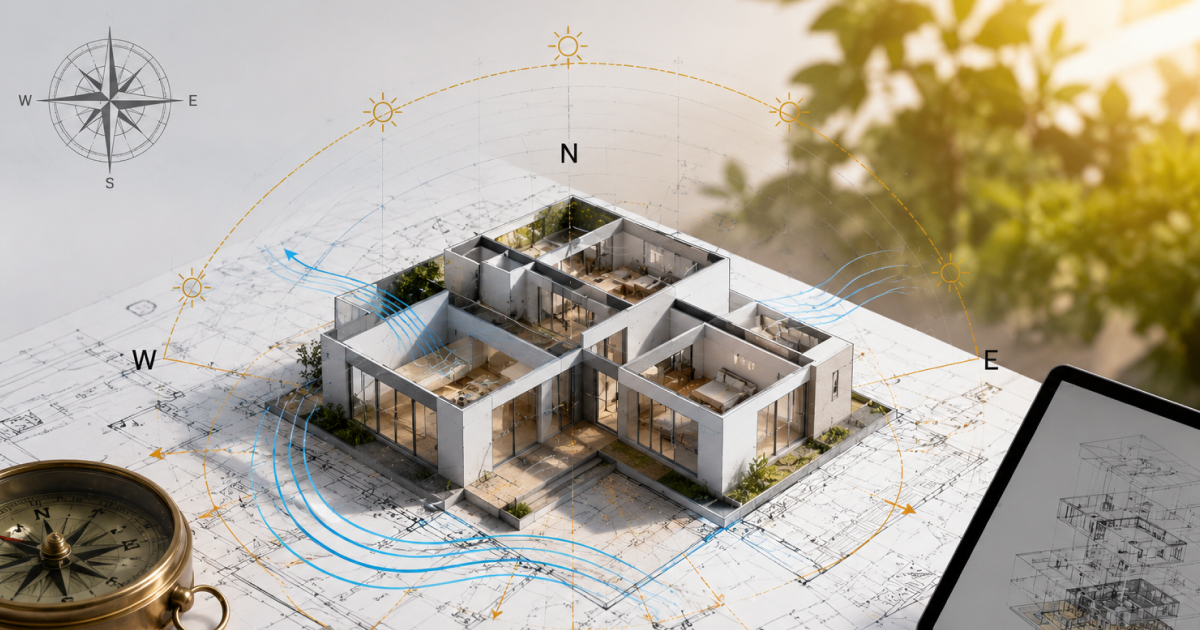
Looking at a layout alone and expecting to understand a building is like looking at a photo of a car and expecting to know how it handles a sharp turn. It’s a static snapshot of a dynamic system. To truly understand how to accelerate sales using your space, you have to stop treating layout, slope, orientation, and movement like independent silos. They are a package deal.
Why a property cannot be fully understood by looking at the layout alone
A 2D floor plan is a lie of omission. It shows where the walls are — not the slope that dictates drainage, the orientation that determines whether your office feels like a sanctuary or an oven, or the light that either energizes your team or makes them squint for eight hours. The layout is just the skeleton. Everything else is the nervous system.
Slope isn’t just about where the rain goes — it’s about the hierarchy of the land. It determines where you place your heaviest machinery and where you welcome your VIP clients. Orientation decides how your building breathes. Get it wrong, and even a Vastu-compliant interior is fighting a losing battle against the elements from day one.
Why movement flow affects how people live, work, and interact
Movement is where the math meets the human. Every time a customer has to double back because a shelf is in the way, or a manager has to walk “the long way” to reach the dispatch bay, you are taxing their energy. When paths are indirect or interrupted, spatial friction accumulates. You don’t see it on the balance sheet immediately, but you see it in the “quiet fatigue” of your staff and the shortened stay-time of your customers.
How technical mapping helps reduce assumption-led planning
This is where spatial consultation moves away from “vibes” and toward blueprints — replacing assumption with measurable environmental logic, and pretty drawings with high-performance systems.
Most inefficiencies don’t announce themselves. They just quietly tax the people working inside them, every single day. Here’s what that looks like when it’s finally caught.
The “Dead Zone” — A Use-Case Study
Picture a logistics unit on the outskirts of Ahmedabad — adequate capacity, sufficient staffing, yet dispatch consistently running behind. Not by hours. Just enough, every day, to compound into something costly.
The receiving and dispatch zones sat on the same directional axis, forcing all inbound and outbound movement through a single corridor. An invisible bottleneck. Goods queuing where they shouldn’t. Staff are doubling back unnecessarily.
No structural changes needed. The inbound staging area shifts to a directionally opposite zone — separating the two flows.
Dispatch clears. Movement becomes linear. The bottleneck dissolves without a single wall touched.
Same warehouse. Same team. The floor, finally, is working with the operation instead of against it.
Your space is either a silent partner or a quiet saboteur. You can keep shuffling furniture and hoping for a miracle — or you can address the technical “why” behind the friction. Because when you finally crack the code on how to accelerate sales using your space, you’ll realize the best investment was never the decor. It was the flow.
What Practical Advantages Can Better Space Planning Create for Homes, Businesses, and Workplaces?
For retail, hospitality, and commercial spaces, the relationship between customer and space directly impacts performance. A customer who moves easily through a well-oriented entrance into a clear display zone is far more likely to engage and decide. One who encounters a confusing path, an awkward counter, or a billing area tucked into the wrong corner is far more likely to leave without completing a transaction.
This is where the floor plan becomes a sales tool — because reducing friction in the customer journey is what allows the commercial exchange to happen naturally.
As a top Vastu expert in Ahmedabad, Jayesh Pandya consistently observes that spatial friction in commercial properties is rarely dramatic. It’s incremental — a slightly misplaced entrance, a display zone in a directional blind spot, a billing counter where customers feel exposed rather than settled. Each element alone is minor. Together, applying vastu for business growth principles can correct these subtle misalignments and prevent them from quietly suppressing performance, turning your space into a natural driver of engagement and sales.
The diagnostic questions for any commercial space:
Does the entrance create immediate ease of entry and a clear sense of what the space offers?
Does customer movement lead naturally toward product, service, or engagement — or does it require active navigation?
Are operational zones clearly separated from customer-facing areas, or do they create visual and physical clutter?
Does the billing or service completion area feel conclusive and easy to reach?
Are waiting zones positioned where customers feel settled, or where they feel exposed and eager to leave?
Where Does Better Space Planning Improve Business and Customer Experience?
Inside workplaces, spatial planning shapes attention, authority, collaboration, and decision flow in ways that only become visible over time — and are almost never traced back to the space that caused them.
Leadership areas without spatial logic produce decisions that feel slow or inconsistent. Not because of the people, because the environment doesn’t support the concentration leadership requires. Meeting rooms placed without regard for movement generate interruptions that break planning rhythm. Focus areas carrying ambient traffic produce a distraction that nobody can identify or source.
For organisations seeking a famous Vastu consultant in Ahmedabad, the value is in the precision of the intervention — not the scale of it. Clearer zoning, better positioning of leadership functions, and deliberate separation of focus and collaboration areas create environments where effort converts more reliably into outcome.
How Does Workspace Alignment Support Team Harmony, Focus, and Leadership Clarity?
Spatial planning shapes attention, authority, and decision flow in ways that only surface over time — and are rarely traced back to the space that caused them.
Leadership zones without spatial logic produce decisions that feel slow. Meeting rooms near high-traffic areas break the planning rhythm. Focus areas carrying ambient movement produce a distraction nobody can name or source.
The value of a famous Vastu consultant in Ahmedabad isn’t in the scale of the intervention — it’s in the precision of it. Because sometimes, the gap between a struggling team and a high-performing one is nothing more than a poorly placed wall. Here’s what that looks like up close.
The “Disconnected Floor” – Industrial Use Case A production facility in Ahmedabad had two teams on the same floor, each performing well individually, yet coordination on shared processes lagged.
The main control room sat next to a high-traffic aisle. Constant movement disrupted attention, while operators’ stations faced away from shared workflow zones — creating subtle, persistent misalignment in operations.
No walls were rebuilt. No equipment was moved. The solution: shift critical operations to quieter corners and reorient workstations to face key workflow areas. Same floor. Same staff. Coordination improved immediately.
Your industrial layout already shapes focus, communication, and output. Misaligned zones silently erode performance — and small spatial adjustments can unlock efficiency, clarity, and measurable productivity.
Alignment was never a people problem. It was a spatial one — and it was one reorientation away from being solved.
Where Does Better Space Planning Improve Everyday Living?
In homes, spatial planning is felt in the quality of daily life — a kitchen that moves with the household, bedrooms that support genuine rest, and living areas that allow ease rather than accidental crowding.
Many well-designed, Vastu-compliant homes still have rooms that sit underused, study areas that never support concentration, and spaces carrying more activity than they should. These aren’t design failures — they’re planning gaps that minimal realignment can correct.
For Vastu for 2BHK in Ahmedabad and larger family homes, the assessment studies how the family actually lives, not a standardised template. Most homes aren’t broken. They’re just slightly out of sync with the people inside them.
The “Unsettled Home” — Industrial Use Case A manufacturing facility in Ahmedabad was fully equipped and operational, yet the workflow felt inefficient. The production line felt congested, storage zones caused operators to constantly turn away from their tasks, and shared zones created interference between teams.
Small spatial misalignments disrupted focus, slowed processes, and increased errors.
Three adjustments. No construction. Workstations and storage were realigned for flow, traffic was reduced in critical zones, and overlapping team areas were separated. Same floor. Same staff. Operational efficiency and clarity improved immediately.
Industrial spaces silently influence output, energy, and coordination — and minor spatial interventions can unlock measurable performance gains.
When Should Spatial Assessment Be Considered?
The most useful time for spatial assessment is before a decision is made — before purchase, before design is finalised, before renovation begins, before a property is occupied by a team or opened to customers. At this stage, the cost of adjustment is lowest, and the benefit of informed planning is highest.
Assessment is equally valuable when a completed space is not performing as expected. A business property that is active but where the workflow lacks clarity. A workplace with persistent focus or coordination concerns. A home that feels effortful to live in despite a completed and well-resourced layout. Homeowners who want improvement but are unwilling to undertake major structural work. These are precisely the situations in which an on-site vastu home visit in Ahmedabad — conducted with precision instruments, blueprint review, and directional mapping — delivers the most actionable output.
The principle is the same at every stage: convert spatial observation into a clear picture of what is creating friction, and produce specific, actionable recommendations rather than generalized suggestions.
How Does an Engineering-Led Spatial Audit Add Clarity Before Action?
An engineering-led audit does not begin with a conclusion. It begins with the property — its orientation, its slope, its access points, its blueprint geometry, its current use patterns. Every element is read in relation to the others. Directional zones are mapped against the actual layout. Movement paths are traced against the positions of functions they are meant to serve.
The output is not a list of general improvements. It is a specific picture of where the spatial logic of the property is working and where it is creating unnecessary friction. This is what Jayesh Pandya delivers as a top Vastu expert in Ahmedabad — a structured, engineering-led assessment that gives builders, business owners, and homeowners a basis for decision-making that is precise rather than speculative.
For builders, this gives greater confidence before handover or marketing. For business owners, it gives a clearer understanding of what the space is doing to commercial performance. For homeowners, it gives a basis for improvement that is proportionate, specific, and implementable without disrupting what has already been built.
Why Can Minimal-Change Realignment Be More Effective Than Large-Scale Redesign?
An engineering-led audit does not begin with a conclusion. It begins with the property — its orientation, its slope, its access points, its blueprint geometry, its current use patterns. Every element is read in relation to the others. Directional zones are mapped against the actual layout. Movement paths are traced against the positions of functions they are meant to serve.
The output is not a list of general improvements. It is a specific picture of where the spatial logic of the property is working and where it is creating unnecessary friction. This is what Jayesh Pandya delivers as a top Vastu expert in Ahmedabad — a structured, engineering-led assessment that applies vastu for business growth principles to give builders, business owners, and homeowners a basis for decision-making that is precise rather than speculative.
For builders, this gives greater confidence before handover or marketing. For business owners, it provides a clearer understanding of what the space is doing to commercial performance. For homeowners, it offers a basis for improvement that is proportionate, specific, and implementable without disrupting what has already been built.
Closing Thoughts
Better industrial or commercial layouts are not defined by how a facility looks. They are defined by how well operations flow, teams collaborate, and processes perform. Even the most advanced machinery or premium finishes cannot compensate for a floor plan that disrupts movement, focus, or output.
Jayesh Pandya, the driving force behind Vaastu Vidyaa, goes beyond equipment placement and structural layouts to understand the system behind industrial spaces. With over two decades of experience, he combines traditional Vastu wisdom with engineering-led logic to ensure every spatial decision supports real operational performance.
When design, direction, and purpose align in an industrial context, a facility does more than operate. It performs consistently, efficiently, and predictably. That is when workflow stops fighting the space, and the space begins supporting the outcomes you want — from productivity and safety to clarity and revenue.
Common Questions Readers Ask
My space is already Vastu-compliant. Do I still need an assessment?
Vastu-compliant doesn't always mean spatially optimised. Compliance covers direction — assessment covers how your space actually performs under real, daily use. The two are not the same.
Can spatial issues be fixed without construction or renovation?
In most cases, yes. The majority of spatial friction is resolved through repositioning, rezoning, and functional realignment — no sledgehammers required.
How is this different from a traditional Vastu consultation?
Traditional Vastu works from rules. Vaastu Vidyaa works from your actual blueprint — mapping slope, orientation, movement, and directional logic together to produce recommendations specific to your property.
Is this relevant for rented spaces where structural changes aren't possible?
Absolutely. Most interventions don't touch the structure. Energetic realignment, functional rezoning, and positional adjustments work within whatever the space already is.
When is the right time to get a spatial audit?
Before a purchase, before construction, or the moment a completed space starts feeling like it's working against you. The earlier, the lower the cost of correction.
Your Space Looks Complete. Let's Make Sure It Performs That Way.